From 2026 to 2031: What the cyclosiloxane restriction really means for medical devices!
With Regulation (EU) 2024/1328 adopted in 2024, the cyclosiloxanes D4, D5, and D6 will gradually be restricted in their use and placing on the market in several types of everyday products. What does this mean for medical devices and their manufacturers?
D4, D5, and D6 are cyclosiloxanes that serve as starting materials for silicone polymers and are used in various industrial applications as processing aids, carriers, or formulation components. These substances have come into regulatory focus because, due to their widespread use, they are associated with persistence and bioaccumulation and, in the case of D4, with potential reproductive toxicity.
This article discusses the nature of these substances, their environmental and toxicological impacts that have led to the new regulation, and, of course, the impact of Regulation (EU) 2024/1328 on medical devices.
What are siloxanes?
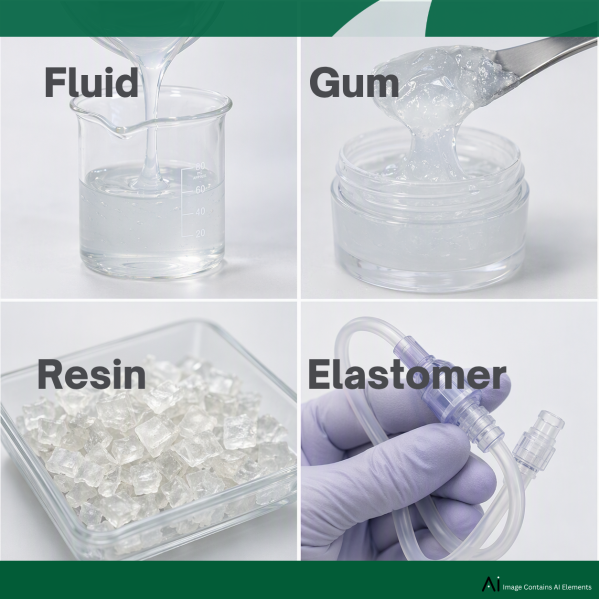
Siloxane is the name given to pluri-functional monomer units composed of silicon, oxygen, and alkane groups: Sil–Ox–Ane. They can form polymers (polysiloxanes or silicones), whose viscosity increases with chain length and therefore molecular weight. Siloxanes can therefore be classified as:
- Fluids = Polymer chains consisting of difunctional units terminated by monofunctional units or cycles. Main uses: hydraulics, release agents, cosmetics, heat transfer fluids, polishes, lubricants, damping, dry cleaning.
- Elastomers = Flexible solids based on cross-linked Si-H fluids. Main uses: tubes and hoses, medical implants, sealants, adhesives, surgical aids, electrical insulation, fuel-resistant rubber parts, rollers, etc.
- Gum = Same structure as fluids, but with a much higher molecular weight. Main uses: high-temperature heat transfer fluids, lubricants, greases, cosmetic and healthcare additives.
- Du Resins = Rigid solids based on trifunctional and tetrafunctional units. Main uses: varnishes, protective coatings, release agents, molding compounds, electronic insulation.
Cyclic siloxanes: D4, D5 and D6!
Cyclic siloxanes are, obsiouly siloxanes but characterized by repetitive units of silicon (Si) and oxygen (O) atoms as well as a closed-loop structure.
Whether as individual substances, in mixtures, or in silicone polymers, they are used in dry cleaning, cosmetics, detergents and cleaning products, pharmaceuticals, and, of course, medical devices.
Out of a total volume of 261,000 tons/year produced and imported, a striking majority, around 87%, is transformed into silicone polymers and compounds. Consumer-oriented applications such as personal care products represent a smaller but still significant segment, while specialized uses in transport, electronics, healthcare, and energy illustrate the material’s versatility across both high-volume and high-performance markets.
This large tonnage represents a significant risk, given the properties of these substances, which are outlined below.
Environmental Impacts & Toxicology!
The observations are straightforward:
- D4 is suspected of reproductive toxicity, is persistent, bioaccumulative, toxic to the environment, and is under evaluation for classification as a Persistent Organic Pollutant (POP).
- D5 and D6 are very persistent and very bioaccumulative in the enviroennement and under evaluation for classification as a Persistent Organic Pollutant (POP).
Used in “leave-on” and “wash-off” cosmetics, D6 accounts for 90% of the 18,000 tons of cyclosiloxanes released into the environment each year. PDMS (a polymer) should not be neglected either; through degradation into D4, D5, and D6, it contributes approximately 45 tons per year per compound to the environment. These substances are very poorly soluble in water and highly volatile, and they strongly adsorb to organic matter.
From a human health perspective, D5 and D6 show low acute and chronic toxicity, with no evidence of genotoxicity or reproductive effects. To date, the effects observed in rats are not considered relevant to humans.
For D4, however, data suggest effects on the estrous cycle and hormonal changes observed in rats. This aspect of endocrine disruption is currently under evaluation. In addition, D4 induces effects documented in rats (reduction in testicular weight, reduction in ovarian weight, and alteration of spermatogenesis at high doses), which led to its classification as Reprotoxic Category 2 (H361f: suspected of damaging fertility).
A broad regulatory framework needed!
Regulatory work has been ongoing since 2015, starting with the UK’s proposal to restrict D4 and D5 in rinse-off cosmetic products. In 2016, ECHA validated the relevance of this restriction based on the characteristics described above. The European Commission subsequently requested an extension to other uses and to D6 in 2018.
In addition, a proposal was made to include D4, D5, and D6 in Annex B of the Stockholm Convention on POPs. All of this led to the adoption of Regulation (EU) 2024/1328 on 16 May 2024, amending Annex XVII of REACH with regard to octamethylcyclotetrasiloxane (D4), decamethylcyclopentasiloxane (D5), and dodecamethylcyclohexasiloxane (D6).
Regulation 2024/1328 amending Annex XVII of REACH!
The new Regulation gives us general restrictions. Indeed, since June 6, 2026, D4, D5, D6 can no longer be placed on the market at concentrations equal to or greater than 0.1% by weight, and the use as solvents in dry cleaning is prohibited. However, recognizing the need for adjustments for manufacturers, the regulation provides for the following deferrals:
- Cosmetic products must be compliant by June 6, 2027.
- Medical devices must be compliant by June 6, 2031.
- Veterinary drugs and products must be compliant by June 6, 2031.
- D5 as a solvent in cleaning is permitted until June 6, 2034.
Thus, MDs/IVDs containing ≥0.1% of D4, D5 and D6 will no longer be able to be placed on the market after June 2031.
However, the socio-economic impact of such an abrupt ban can be significant for manufacturers of medical devices, requiring reformulation, additional R&D, new approvals, increased regulatory burden, or, in the worst case, loss of market access and potential impact on patient care. Therefore, given these challenges, exemptions have been introduced.
Exemptions!
The marketing ban does not apply to certain industrial uses (e.g. production of silicone polymers, polymerization monomers, formulation of mixtures, production of articles, non-metallic surface treatment).
For medical devices specifically, the placing on the market of D5 and D6 is permitted in certain cases (e.g. treatment and care of scars and injuries, injury prevention, ostomy care, or in the form of silicone polymer residues), under the following conditions:
- They are present at ≤0.2% in MDs within the meaning of Regulations (EU) 2017/745 and 2017/746
- D5 is present at ≤0.3% or D6 at ≤1% in MDs for dental printing
If no applicable exemption exists for an MD/IVD, the marketing ban applies after June 6, 2031.
What does this mean regarding my MD?
The first questions to ask are whether the MD falls within the scope of the restriction and, if so, whether any exemptions apply.
In practice, the difficulty lies in the fact that D4, D5, and D6 often do not appear as intentionally added components but rather as residues from manufacturing processes in silicone materials. Fully polymerized silicone polymers are not equivalent to cyclosiloxanes but may contain residual amounts of their starting materials that become regulatory relevant.
Therefore, without credible data on extractables and leachables, both REACH compliance and biological evaluation in accordance with ISO 10993 and the MDR remain uncertain. In the absence of such data, manufacturers risk regulatory follow-up questions from Notified Bodies, delays in conformity assessment procedures, or even rejection of CE marking.
The first sensible step is therefore a structured clarification of the materials used. Manufacturers should systematically assess whether D4, D5, or D6 may be present in materials, precursor products, or along the supply chain.
Only on this basis can it be determined:
- whether chemical characterization according to ISO 10993-18 is required
- whether existing biological evaluations must be updated
- whether a toxicological risk assessment is necessary
- whether regulatory threshold values are reached or exceeded
This sequence is critical. Without reliable substance data, any evaluation remains uncertain.
TentaConsult – Your Partner for Chemical Characterisation, Biological Evaluation and MDR‑Compliant Documentation!
TentaConsult supports medical device manufacturers in systematically analysing material data, planning targeted chemical characterizations, and building biologically sound and regulatory-compliant evaluations. At the interface between REACH and MDR, a robust and well-structured data foundation is the key to identifying risks early and closing documentation gaps.
This approach turns an abstract regulatory deadline into a concrete action strategy, enhancing regulatory certainty and improving preparedness for assessments by Notified Bodies. We support you from initial material testing to complete technical documentation and prepare you thoroughly for conformity assessments.
Sources:
- European Chemicals Agency (ECHA). Octamethylcyclotetrasiloxane (D4); decamethylcyclopentasiloxane (D5); dodecamethylcyclohexasiloxane (D6): Restriction.
https://chem.echa.europa.eu/100.256.323/activities/restrictionProcess/144f2fb282e27d99c48dae549f37a7c1 - European Chemicals Agency (ECHA). Cyclosiloxanes.https://echa.europa.eu/fr/hot-topics/cyclosiloxanes
- Silicones Europe. (2024). Impact assessment on the nomination of D4, D5, and D6 to the Stockholm Convention.https://www.silicones.eu/impact-assessment-on-the-nomination-of-d4-d5-and-d6-to-the-stockholm-convention/European Union. (2024). Regulation (EU) 2024/1328.https://eur-lex.europa.eu/eli/reg/2024/1328/oj/eng
For for further information please contact us freely.